KR: Exercise 1
Stitches puzzle
 |
|
 |
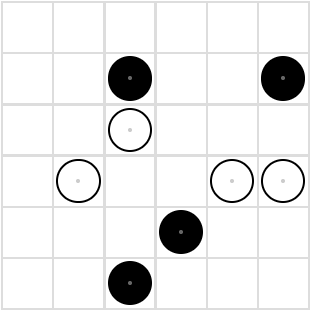
| Initial configuration.
M=1 |
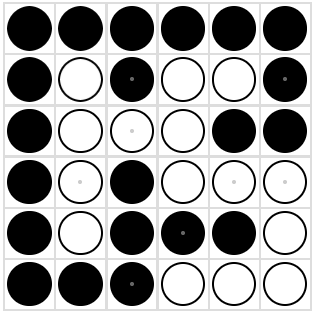
Solution |
Introduction
In this exercise we will use clingo to find
solutions to the Stitches puzzle.
The initial state is an empty square grid of N x N
cells that is organized in irregular regions of
adjacent cells. For instance, in the example above, we
have a 5 x 5 grid with 5 regions of different numbers of
cells: from top to down, left to right, regions of sizes
2, 7, 4, 3, 9. The goal of the puzzle is placing stitches:
a "stitch" is a vertical or horizontal connection of two
adjacent cells. Each cell connected by a stitch is called
a "hole". The constraints of the puzzle are as follows:
- Each stitch must connect two different regions
- Two stitches cannot share a hole
- Every pair of adjacent regions must be connected
by a fixed number M>0 of stitches
- The numbers in the upmost row indicate the total number of holes per each column
- The numbers in the leftmost column indicate the
number of holes per each row
Steps
-
Encode the Stitches problem as an ASP program that solves the puzzle for any instance. This program is our Knowledge Base and will be called stitches.lp
NOTE: student groups will use one of the different notations to refer the cell positions in the grid
Type 0: denote each cell position as a pair (X,Y) where X is the row, from the upmost row 0 to the lowest row N-1, and Y is the column, from leftmost 0 to N-1 rightmost.
Type 1: denote each cell with a unique integer number from 0 to (N x N)-1 going from up to down and left to right. For instance, in the example with N=5, the first row would be positions 0..4 from left to right, the second row 5..9 etc until the last row 20..24.
Type 2: denote each cell position as a pair (X,Y) where X is the column from 1 (the leftmost column) to N (the rightmost column) and Y is the row from 1 (the lowest row) to N (the upmost row).
To know which type you belong to: from the two students forming the group, take the last name of the one alphabetically lower and count the number of letters, making modulo 3. Example, if the students last names are "Fernández López" and "Johnson", the alphabetically lower is "Fernández" the total number of letters is 9 and 9 modulo 3 is = Type 0. As another example, if the students last names are "Pérez Ruiz" and "Gómez García" the lower last name is "Gómez" = 5 letters and 5 modulo 3 = Type 2.
-
Each puzzle instance will be provided as an ASCII file domXX.txt with the following format. The first line contains the two numbers N and M. Then, we have a grid of N x N characters where each letter a, b, c, d, etc, in the grid means that the corresponding cell belongs to a region named with that letter. Finally, we have two lines of N numbers corresponding to number of holes per column and number of holes per row, respectively. As an example, the input file for the initial configuration in the picture above could look like:
5 1
aabbc
bbbbc
dbecc
ddeee
eeeee
2 3 3 2 2
2 2 4 3 1
You will create a python program called encode.py that takes each domXX.txt file as an input and creates an domXX.lp file describing the instance as a set of ASP facts using your representation of the problem. An example of use could be:
python3 encode.py dom02.txt dom02.lp
Warning: domain files domXX.lp can only contain facts and constants. Other rules or constraints are not allowed in domain files.
-
Finally, we will translate back the answer set into a complete Stitches solution, using the following notation:
As an illustration, the solution in the example puzzle above corresponds to the output file
- ">" followed by "<" denotes an horizontal stitch
- "v" with "^" below denotes a vertical stitch
- "." denotes an empty cell without holes
| .><.. ..vv. .v^^v v^..^ ^.... |
To print this output you will build the a python program decode.py to be used as follows
python3 decode.py stitches.lp dom02.lp sol02.txt
As a starting point to create this file, you can use the example decodeexample.py that retrives in python the arguments of two predicates "q(N)" where N is a number and "p(X,N)" where X is a string and N is a number. To see its effect, use it for instance with the logic program (program.lp):
q(1..5).
p((a;b;c), 1..3).
and call python3 decodeexample.py program.lp
NEW: examples.zip containing a benchmark with several domains and their unique solutions.
Assessment and Delivery
The maximum grade for this exercise is 1.5 points = 15% of the
course.
Warning:
exercises must be made by groups of 2 students.
If you do not have an assignment companion, please
contact with Pedro Cabalar to organize a matching or
find an alternative. Individual assignments
submitted without the professor's permission will be
automatically rejected.
Delivery: upload the assignment in a
single .zip file containg
- a README.txt file with your names, the position encoding type you got assigned (0, 1, or 2) and any additional remark needed to execute the code, if needed.
- The files stitches.lp, encode.py and decode.py
- If you have tried multiple versions of stitches.lp you can include them and comment their meaning in the README.txt
- DO NOT INCLUDE: example files or other support
material already contained in the current web page
Deadline: April 10th 2026 (23:59).
IMPORTANT: Assignments may be required to pass through a
defense exam.
If this is the case, it will be announced in the first,
preliminary list of grades. The defense exam will
consist of multiple questions about the submitted
assignment to explain code, fill missing parts or make
small variations.